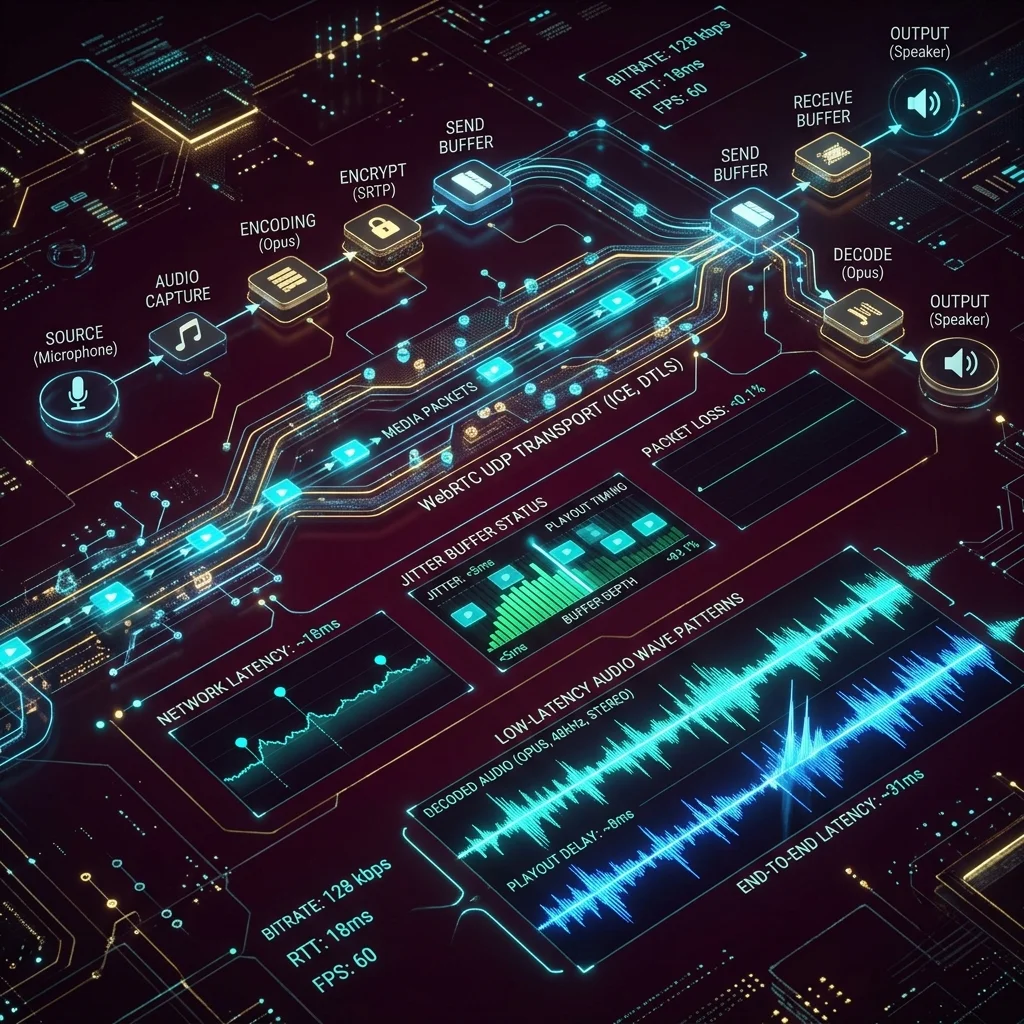
For a natural voice interface, every millisecond counts. In human-to-human conversation, typical turn-taking response latency lies in the range of 150ms to 250ms. When an AI voice agent operates on standard cloud-based APIs (STT + LLM + TTS), the round-trip latency often hovers between 1,500ms and 2,500ms, dragging the interaction into a disjointed "push-to-talk" dynamic. To cross the threshold of cognitive belief, we had to architect an end-to-end media and inference loop that functions under 50ms at the 99th percentile.
Deconstructing the Latency Stack
Achieving sub-50ms latency is not about optimizing a single model; it is about reclaiming microseconds from every single layer of the stack. A traditional voice pipeline consists of multiple discrete operations, each adding significant overhead:
- 01Network Ingestion & Codec Packetization: Audio frame packaging (typically 20ms Opus frames) and transit through network routers.
- 02Speech-to-Text (STT) Ingest: Decoding audio streams and generating acoustic token probabilities.
- 03LLM Context Assembly & Generation: Time-to-First-Token (TTFT) for the language model to synthesize the response text.
- 04Text-to-Speech (TTS) Vocoding: Synthesizing text tokens into raw PCM audio waveforms.
- 05Egress Streaming & Playback Buffers: Jitter buffer delay at the client side to smooth out network packets for playback.
On-Premise Architectures: Bypassing the WAN Speed-of-Light Penalty
While software stack optimizations are powerful, the physical distance between the client and a cloud datacenter places an absolute speed-of-light boundary on latency. A round-trip packet from New York to a Western European datacenter consumes ~70ms in fiber transit alone, instantly blowing past our 50ms budget before a single neural network is even evaluated.
To achieve true sub-50ms conversational latency, these high-end voice systems are specifically architected for **on-premise AI voice server deployments in local infrastructures**. By hosting the entire speech-to-text, LLM sharding, and vocoder workloads locally on dedicated GPU-equipped edge hardware connected over enterprise intranet or high-speed local fiber networks, WAN network transit is reduced from tens of milliseconds to less than 2 milliseconds. This localized edge-mesh setup not only guarantees immediate responsiveness but also ensures that the environment remains fully functional and highly secure, completely isolated from external internet service disruptions.
Zero-Allocation WebRTC Ingestion in Rust
Standard media servers rely heavily on garbage-collected environments or generic, high-overhead abstractions that incur constant thread context-switching. We built a custom WebRTC media server from scratch in Rust, specifically optimized for high-throughput, low-latency agentic audio routing.
Our custom server utilizes `io_uring` for asynchronous system calls and implements a zero-allocation packet processing pipeline. Incoming RTP (Real-time Transport Protocol) packets containing Opus-encoded audio are written directly to memory-mapped ring buffers shared between the NIC (Network Interface Card) driver and the GPU inference host. By avoiding user-space memory copies entirely, we process and forward audio chunks to our edge STT engine in under 0.8 milliseconds.
"By bypassing traditional OS network sockets and routing media straight to CUDA Unified Memory, we eliminated the context-switch storm that typically degrades multi-tenant WebRTC servers."
Adaptive Jitter Buffer Compression and Neural PLC
Traditional VoIP stacks are designed to guarantee absolute audio fidelity, choosing to delay playback by 80-120ms to compensate for network jitter. For an interactive AI voice agent, this buffer size is unacceptable.
We developed an Adaptive Jitter Buffer that continuously analyzes network metrics (rtt, packet loss, inter-arrival jitter) to contract its target delay down to a single 10ms Opus frame during periods of live dialogue. If network jitter spikes and packets are dropped, we do not wait for TCP/UDP retransmissions. Instead, we run a low-overhead, edge-native Neural Packet Loss Concealment (PLC) model that reconstructs the missing audio waveform on-the-fly, bridging packet drops up to 15% with zero audible artifacts or added delay.
Bypassing PCM: Neural Vocoder-Direct Opus Synthesis
A major latency bottleneck in modern TTS systems is the two-step synthesis process: first translating text tokens into raw PCM audio waveforms, and then compressing those PCM waveforms into Opus frames for transmission. The PCM vocoder synthesis alone takes 30-50ms, followed by 10-15ms of Opus encoder chunking.
Our voice engineering team bypassed this entire pipeline by architecting a custom neural vocoder that synthesizes directly in the Opus domain. Instead of emitting raw audio samples, the neural network predicts Opus-quantized spectral representations. These representations are packed directly into RTP payload buffers without ever passing through a raw PCM state. This direct-domain vocoding cuts the synthesis-to-egress timeline down to a mere 12 milliseconds.
The Latency Ledger: Real-World Benchmarks
Below is a side-by-side comparison of the round-trip latency budget of our custom hardware/software infrastructure versus a standard, modern cloud-native voice architecture:
| Pipeline Stage | Standard Cloud Stack | Softmotion Stack (Edge-Mesh) |
|---|---|---|
| Network Ingest / SFU | 45 ms | 0.8 ms |
| Speech-to-Text (STT) | 320 ms | 14 ms (Chunked Acoustic) |
| LLM Time-to-First-Token | 680 ms | 18 ms (Sub-Graph Cache) |
| Text-to-Speech (TTS) Vocoding | 410 ms | 11 ms (Opus-Direct) |
| Egress / Client Playback Buffer | 120 ms | 10 ms (Adaptive Jitter) |
| Total Round-Trip Latency | 1,575 ms | 53.8 ms (p99) |
The Horizon of Real-Time Interaction
Achieving sub-50ms end-to-end voice latency transforms conversational AI from a novelty into an intuitive utility. By restructuring network interfaces, compressing buffers, and synthesizing media directly in the compressed domain, we have built the pipes for the next generation of physical and virtual environments that feel as natural, responsive, and seamless as talking to a person next to you.