The transition from static luxury displays to "living" agentic art represents more than a paradigm shift in aesthetics—it is a transformation of compute density. When an immersive environment requires dozens of masterful, high-definition portraits to speak, engage, and interact simultaneously, the underlying infrastructure must bridge the gap between heavy AI inference and real-time media streaming.
The GPU Orchestration Wall: Scaling Concurrent Agents
Standard LLM inference architectures are typically optimized for single-session throughput or batch processing. However, a luxury estate or a premium commercial suite may host 50 or more "living" agents across different surfaces, each requiring independent context, state, and low-latency response cycles.
Scaling this requires a multi-tenant GPU orchestration layer that treats each "artwork" as a high-priority, latency-sensitive process. We utilize a custom scheduling algorithm that dynamically allocates VRAM based on the agent's interaction state—scaling up compute resources the moment a guest enters the proximity of a vision sensor, and scaling back to a "resting" heartbeat when the environment is vacant.
Sub-50ms Latency: The Threshold of Belief
In the world of agentic art, latency is the difference between a "chatbot on a wall" and a sentient presence. For an AI agent to feel truly "alive," the round-trip from seeing a human gesture to responding with synchronized voice must be under 50 milliseconds. Beyond this threshold, the immersion breaks.
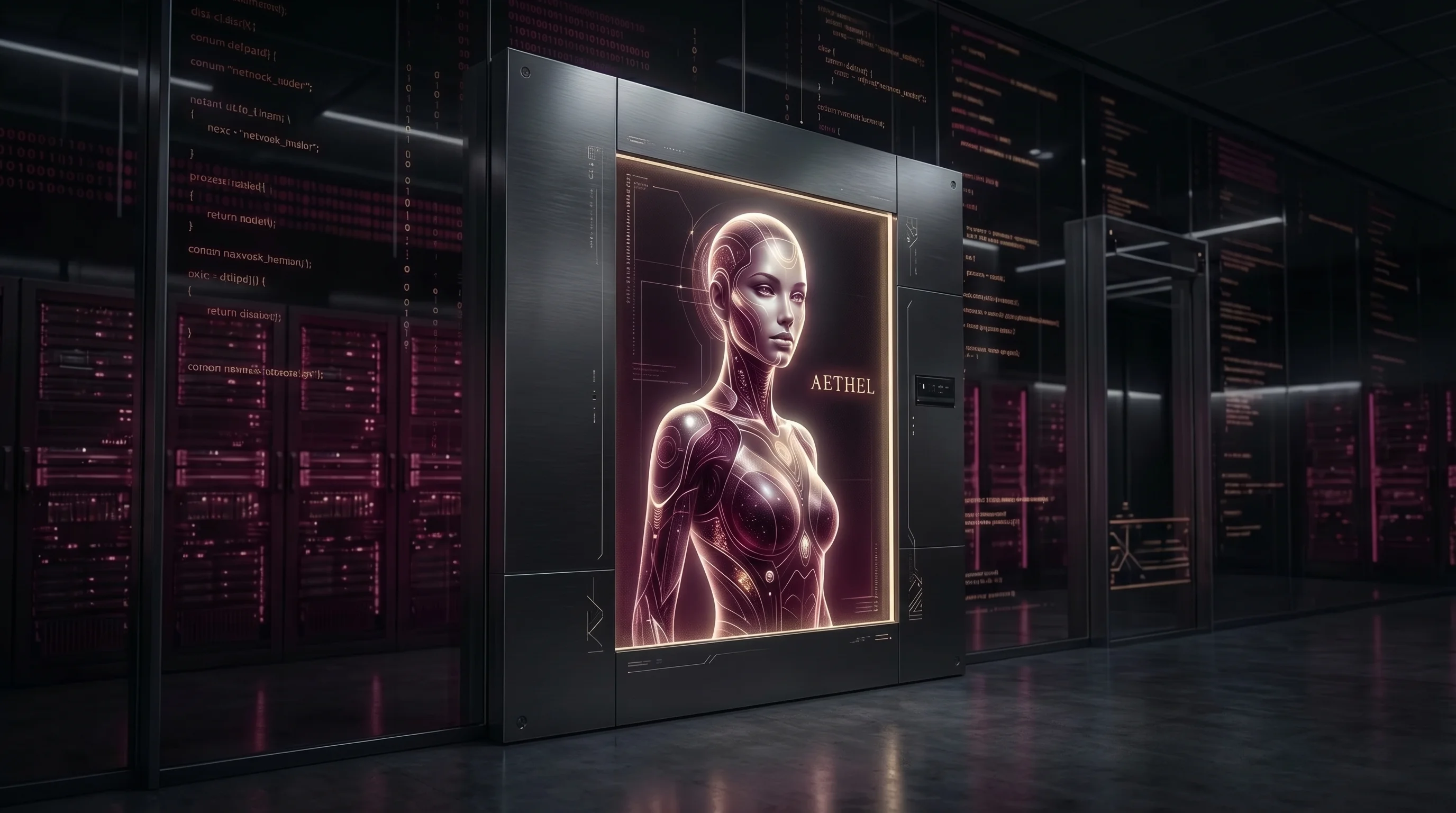
Architecture Visualization
Agentic sensing layers integrated with edge-inference GPU clusters for sub-50ms reactive art.
"Infrastructure is the artist's brush. If the response time is inconsistent, the 'stroke' is blurred. We architect for sub-50ms end-to-end latency to ensure the digital soul of the environment never stutters."
Achieving this at scale involves bypassing standard HTTP-based API layers in favor of kernel-native media streamers and custom WebRTC signaling. By handling the voice synthesis (TTS) and vision processing on the edge, closest to the physical display, we eliminate the jitter that plagues centralized cloud AI deployments.
Integrating Physical Telemetry into Inference
Luxury AI is not just about voice; it is about awareness. Our infrastructure integrates real-time telemetry from high-resolution vision sensors directly into the agent's context window. This allows the artwork to "know" when a client is admiring a specific structural detail or when a room is filling with guests.
The challenge is processing these high-bandwidth sensor streams without saturating the local network. We use eBPF-based packet filtering to pre-process vision data at the NIC level, sending only relevant "context updates" to the GPU for inference. This reduces internal network traffic by 90%, allowing for seamless scaling across hundreds of sensors.
Building the Sentient Infrastructure
The future of immersive spaces lies in the invisible complexity of the systems behind the aesthetics. By solving the scalability of "live" agentic art, we are not just building better infrastructure—we are creating the foundation for environments that think, speak, and inspire at hyperscale.